
Advantages of Front Lights
Structure
A backlight requires at least four components including the light source, while a front light can be configured using only a light guide plate and a light source.
Cost
With fewer components than a backlight, front lights offer substantial cost savings.
Light Quality
The display is illuminated evenly across the entire surface, providing clear, high-quality visibility with a sense of depth.
Brightness
Although the light output is lower than that of high-brightness backlights, front lights provide sufficient illumination for clear visibility in low-light or nighttime environments.
For LCD applications, they are not affected by panel transmittance.
Color
Using LED light sources allows for a wide range of color options.
Visibility
Although the light guide plate is positioned in front of the display, high transparency ensures a clear and unobstructed view.
Thickness
Typically around 1 mm thick, with flexibility to adjust thickness depending on product requirements.
Its slim profile makes it ideal for applications with limited space.
Size
When directly processed on acrylic plates, sizes up to 1000 × 1000 mm are supported.
Illumination Mechanism: Front Light vs. Backlight
Front Light Structure
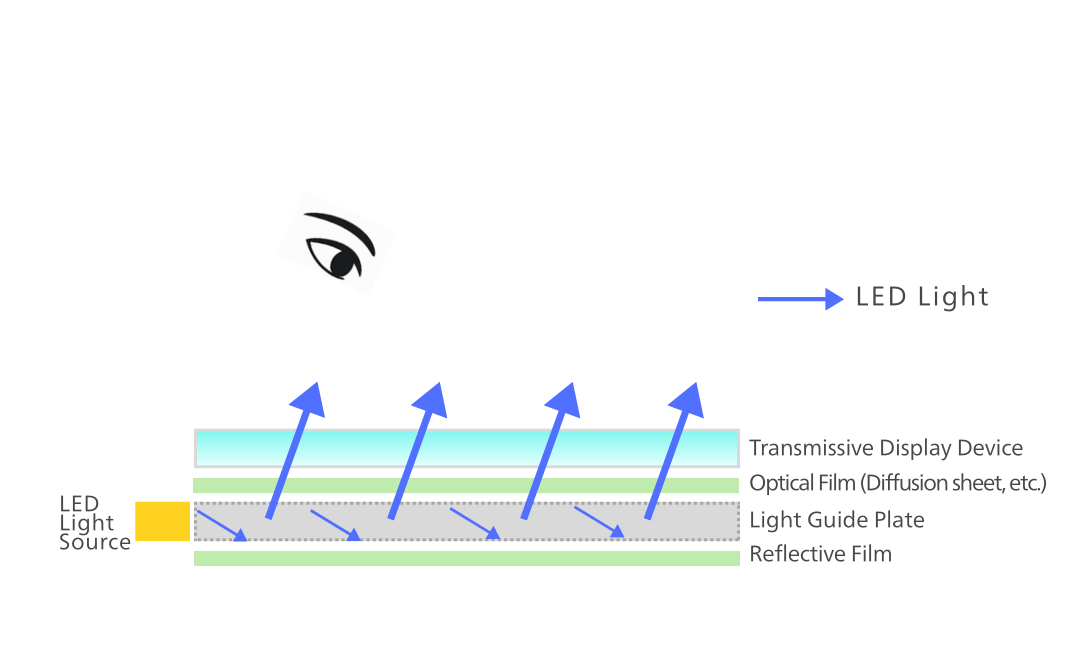
As shown in the diagram below, the light guide plate is placed on the front side of the display.
In dark environments, LEDs are activated to evenly illuminate the display surface and enhance image clarity.
In bright environments, the display can be viewed using ambient light without turning on the LEDs.
This simple configuration requires fewer components.
Key Benefits
Simple structure:
Minimal number of components
Low cost:
Fewer parts compared to backlights
Low power consumption:
LED lighting is unnecessary when ambient light is available
Applications of Front Lights
Front lights are used not only in electronic devices such as e-paper displays, but also in automotive components.
In addition, their ability to be placed on the front surface while maintaining high transparency has expanded their use in illuminated displays for amusement equipment and signage applications.
・E-paper devices / electronic notebooks
・Reflective LCDs (industrial handheld terminals, meters, measuring instruments)
・Analog displays, clocks, and gauges
・Low-power signage and battery-operated information displays
・Wearable and healthcare devices, and more



![株式会社押野電気製作所 [本社] 〒140-0011 東京都品川区東大井 5−12−10 大井朝陽ビル4階TEL:03-3471-8548(代)](/wp-content/themes/oshino/images/common/footer-about-en.svg?20211228)
